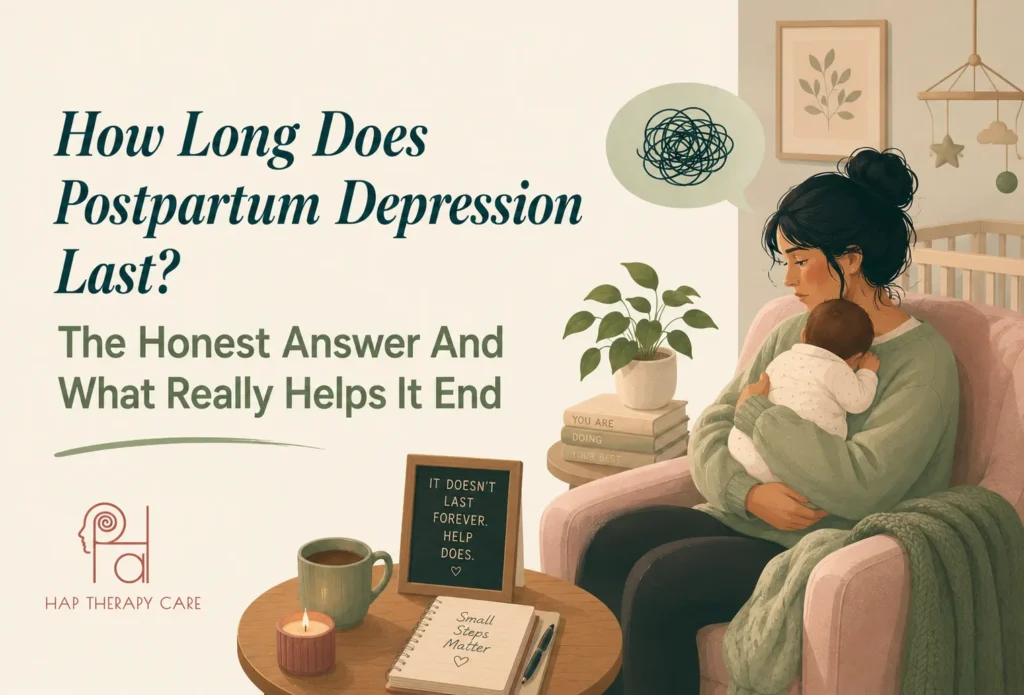
Everyone mentioned the baby blues, that weepy, raw week or two after delivery, where your hormones crash, and you cry at commercials.
People talk about that. What they do not talk about is the version where you are eight months postpartum, typing “how long can postpartum depression last” into a search bar at 2 am when scrolling seems like the only good choice.
If that is where you are right now, this article is for you. Not a vague “you are not alone” post, but real answers.
What the Research Actually Says About How Long Postpartum Depression Lasts
Without treatment, postpartum depression can last anywhere from 3 to 12 months and, in some cases, significantly longer. A study published in Pediatrics, tracking over 4,800 mothers for three years, found that about 5% had persistently high depressive symptoms throughout the entire period, and for some, symptoms worsened over time rather than improving.
With appropriate support, most mothers show meaningful improvement within 3 to 6 months. That gap between untreated and supported is worth sitting with for a moment.
There is no single normal timeline.
PPD does not run on a schedule, and it does not care that your baby is now crawling or that everyone keeps saying you look great. What matters is that the duration is not fixed and can change, as the research consistently shows, with the right help.
Did You Know?
· Up to 1 in 5 mothers in Ontario experience postpartum depression or anxiety, yet fewer than half receive a formal diagnosis or treatment. (CAMH)
· Research suggests up to 50% of mothers with PPD never receive treatment at all
· Untreated PPD has been linked to longer recovery times, impacts on mother-infant bonding, and increased risk of future depressive episodes
· Online counselling has demonstrated outcomes comparable to in-person therapy for PPD, making it a real, evidence-backed option
What Makes Postpartum Depression Last Longer?
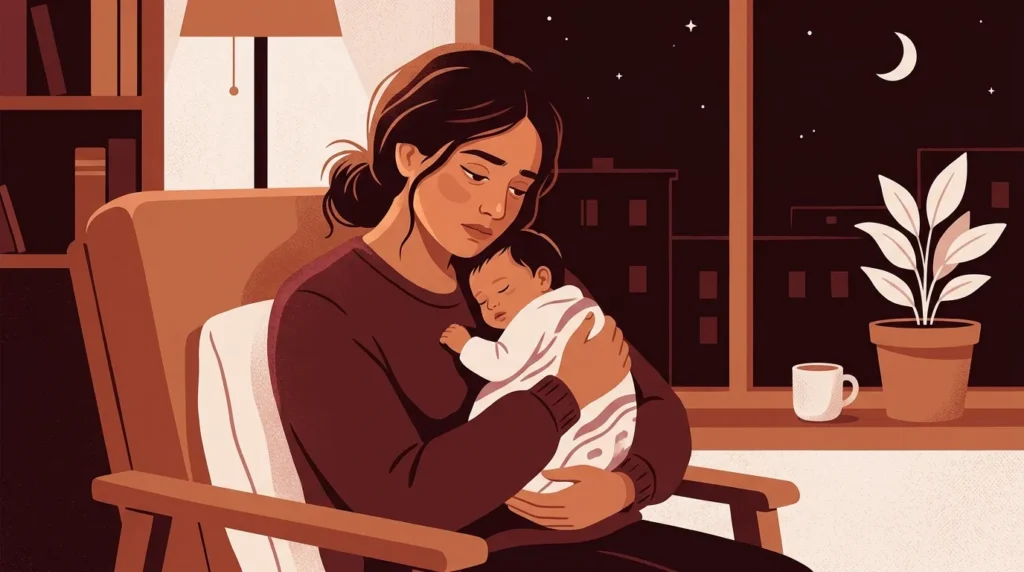
This is not a guilt list. These are the things that keep PPD going – and, more importantly, things that can be addressed.
- Delayed or absent support: The most consistent factor across the research. The longer someone waits without treatment, the more entrenched the patterns become. This is not a character flaw. It is biology meeting circumstance.
- Sleep deprivation and physical depletion: Both a symptom and a driver. Your nervous system cannot regulate when it is running on empty.
- Isolation: Amplifies everything. When you are not connecting with others, the thoughts loop. Many mothers across Ontario, especially those who have relocated or live away from extended family, describe this loneliness as one of the hardest parts.
- Previous history of depression or anxiety: This can make recovery longer, not because it is inevitable, but because there is more to untangle.
- Cultural stigma: This deserves its own mention. As an Indo-Canadian who immigrated from India, I have seen this from the inside, not just as a therapist, but as someone who lived through the pressure to appear strong, capable, and grateful while quietly struggling.
- In South Asian communities, including Tamil and Indian families across Ontario, this silence is common. Saying “I am struggling” can feel like saying “I am failing.” The fear is real, and it delays help in ways that extend suffering unnecessarily.
- Relationship stress and financial pressure: Subtler contributors that rarely appear in medical checklists but come up in almost every therapy room.
Wait – Is It Definitely PPD?
Something that gets missed often: many mothers searching “how long can postpartum depression last” are actually experiencing postpartum anxiety, not depression, or a combination of both.
Postpartum Depression (PPD) tends to show up as persistent sadness, difficulty connecting with your baby, emotional numbness, or a creeping hopelessness that will not lift.
Postpartum anxiety (PPA) looks more like a racing mind that refuses to turn off, physical tension, hypervigilance about your baby’s safety, and a constant low hum of dread – even when nothing is visibly wrong.
Both are valid. Both are more common than most people know. And both respond well to the right support.
How Have You Been Feeling?
Not a diagnosis — just a moment of reflection.
In the past two weeks, what has felt more present?
Has it been more than a couple of weeks since you felt like yourself?
What Actually Helps Postpartum Depression End Faster
Therapy, mainly Cognitive Behavioural Therapy (CBT) and Interpersonal Therapy (IPT), has the strongest evidence base for PPD recovery. IPT in particular was developed with relationship and life-transition work at its centre, which maps closely onto the postpartum experience.
Beyond formal therapy, the research points consistently to:
- Sleep intervention wherever possible
- Reducing isolation, even in small ways
- Partner and family education, so that home support is actually supportive
- Medication in moderate to severe cases – a legitimate and evidence-backed part of treatment for many mothers
Recovery usually takes a combination – not one single fix. And that combination looks different for everyone.
On Waiting It Out – When Is That the Wrong Call?
For very mild PPD, some mothers do find that it resolves on its own, particularly with strong social support. That happens.
But moderate to severe PPD, the kind where you have felt this way for months, rarely resolves fully without support. The documented risks of untreated PPD extend beyond the mother. Research shows real impacts on mother-infant bonding and the child’s developmental outcomes.
This is not meant to frighten you. It is meant to let you know that early support significantly changes the trajectory.
You Do Not Have to Wait for It to Pass on Its Own
Whether you are looking for postpartum counselling in Toronto, Mississauga, Ottawa, or anywhere else across the province, Hap Therapy Care offers fully online therapy for postpartum depression and anxiety, which means no childcare to arrange, no commute, no waiting room. Just support, from wherever you are.
If you have been looking for a therapist who already understands your cultural world without needing it explained – the family expectations, the pressure to hold it together, the fear of being judged for struggling, you will not have to start from scratch here.
Hareesma is an Indo-Canadian who immigrated from India and has navigated the same transitions many of her clients are going through: building a life in a new country, managing community expectations, and learning to ask for help in a culture that does not always make that easy. That lived experience is part of every session.
The first step is a free 15-minute discovery call, no commitment, no intake forms at the door. Just a conversation to see if this feels right.
To learn more about what sessions cover, visit the services page. For mothers specifically navigating the postpartum period, postpartum counselling is available online across Ontario.
Frequently Asked Questions
Can postpartum depression last for years?
Yes. Without treatment, PPD can persist for two years or more, and in some cases longer. A major study tracking over 4,800 mothers found that about 5% still had high depressive symptoms three years after giving birth, with some worsening over time.
This is one of the clearest reasons why seeking support early, rather than waiting to see if it passes, makes a significant difference to recovery time and quality of life.
What is the difference between baby blues and postpartum depression?
Baby blues typically appear within the first few days after delivery and resolve within two weeks. They are emotionally difficult but manageable. Postpartum depression persists beyond two weeks, intensifies rather than fades, and affects your ability to care for yourself and connect with your baby.
Can postpartum depression start months after giving birth?
Yes. PPD can begin up to 12 months postpartum. Some mothers feel relatively fine initially and notice symptoms emerging later as sleep deprivation accumulates or the early excitement of new parenthood settles.
Does postpartum depression go away without therapy?
Mild PPD can sometimes resolve with strong social support. But moderate to severe PPD rarely resolves completely without professional help. If symptoms continue to affect your daily functioning or your sense of yourself, therapy is the most direct route to real recovery.
Is online counselling effective for postpartum depression?
Yes. Research consistently supports online therapy for PPD, with outcomes comparable to in-person work. For mothers who find it difficult to leave the house – or who live in smaller Ontario cities without local specialist access – it removes one of the biggest practical barriers to getting help.
Do I need a referral from my doctor?
No. In Ontario, you can access a registered psychotherapist directly, without a GP referral. You can book a free discovery call today.