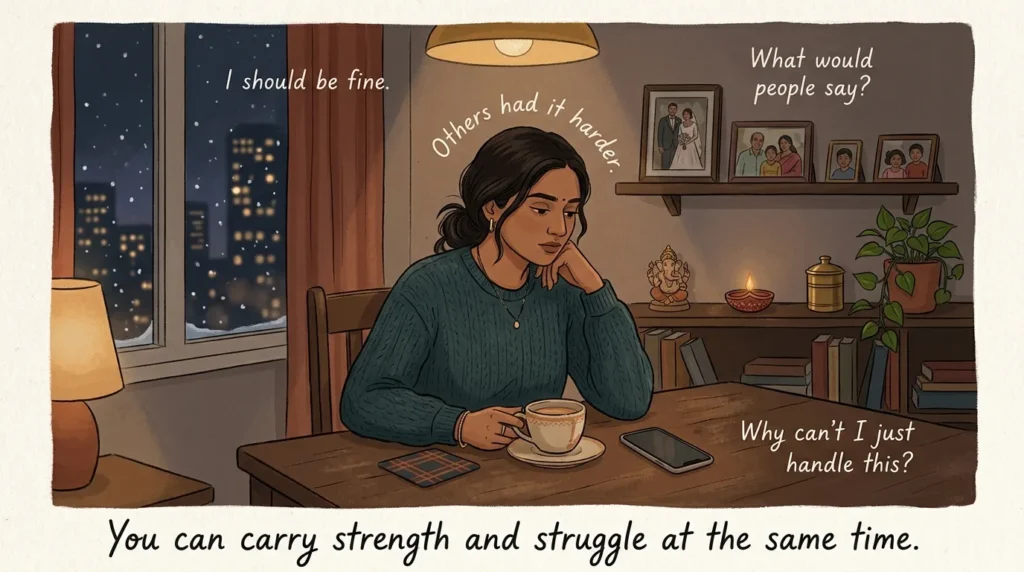
There is an internal monologue many South Asians know well: ‘I should be fine. Others had it so much harder. Amma and Appa sacrificed everything, moreover what do I even have to complain about? And what would people say if they knew I was seeing a therapist?’
If any of that resonates, you are not alone, and you are not weak for feeling it.
Privately stretched. Publicly composed. Never quite sure whether therapy is something designed for people like us. This is where millions of South Asian adults quietly live.
But it definitely is, when it’s done right. Read on to know how unaddressed stress affects and answers related to therapy for south asian mental health
Is This You?
Tick what resonates — no right or wrong answers.
I tell myself I should be fine; others have it worse.
I worry what my family or community would think if they knew.
I feel caught between two cultures and don’t fully belong to either.
I feel pressure to succeed and not disappoint my parents.
I carry stress in my body: headaches, poor sleep, constant tension.
I have thought about therapy, but kept finding reasons to delay.
Got 3 or more? This blog was written for you. What you’re carrying is real and you don’t have to carry it alone.
Where Does the Resistance to Therapy for South Asians Arise From
The reluctance isn’t ignorance; it comes from real, coherent values.
In most South Asian households, personal struggle is a collective matter. Mental health struggles have been framed through spiritual or moral lenses: something to endure, pray through, or overcome through discipline.
For the generation that immigrated with no safety net, survival genuinely needed compartmentalising.
There’s a phrase in Hindi and Urdu, 'log kya kahenge', which means, " what will people say. It is one of the most powerful invisible barriers to seeking help because therapy, by definition & perception, crosses a private threshold.
And, for communities where family reputation is deeply tied to collective values and honour, that feels like a genuine risk, not paranoia. These aren’t irrational fears, but cultural beliefs worth understanding, not dismissing.
Did you know? CAMH (2023) found that South Asians in Canada have higher rates of anxiety & mood disorders, but are 85% less likely to seek treatment. The gap is not in how much we suffer, but in how rarely we reach out.
How Does Unaddressed Mental Health Pressure Among South Asians Look Like?
Unaddressed anxiety in a South Asian context rarely announces itself. It builds up quietly, over the years, in patterns worth noticing:
| Experience | What It Can Look Like |
|---|---|
| Physical symptoms that never fully resolve | • Chronic headaches • Insomnia and digestive discomfort • Constant fatigue • The body carrying what the mind has not had space to process emotionally |
| Relationship conflicts across generations | • Ongoing tension between you and your parents • Emotional patterns repeated across generations • Unexamined struggles quietly getting transferred forward |
| High-functioning anxiety | • Good grades and career growth still continuing • Outward composure remaining intact • Internal exhaustion and emotional depletion building quietly over time |
| The loneliness of starting over | • Academic pressure and financial stress • Isolation and homesickness • Adapting to unfamiliar environments • Not feeling culturally safe enough to ask for support |
Did you know? Statistics Canada’s Mental Health Survey (2022) noted that lower reported mental health rates among South Asian Canadians may reflect stigma, partly, & under-reporting, rather than true lower rates.
We are not struggling less. We are disclosing less.
Why Standard Therapy Can Feel Like a Poor Fit And How a South Asian Therapist in Ontario Can Help?
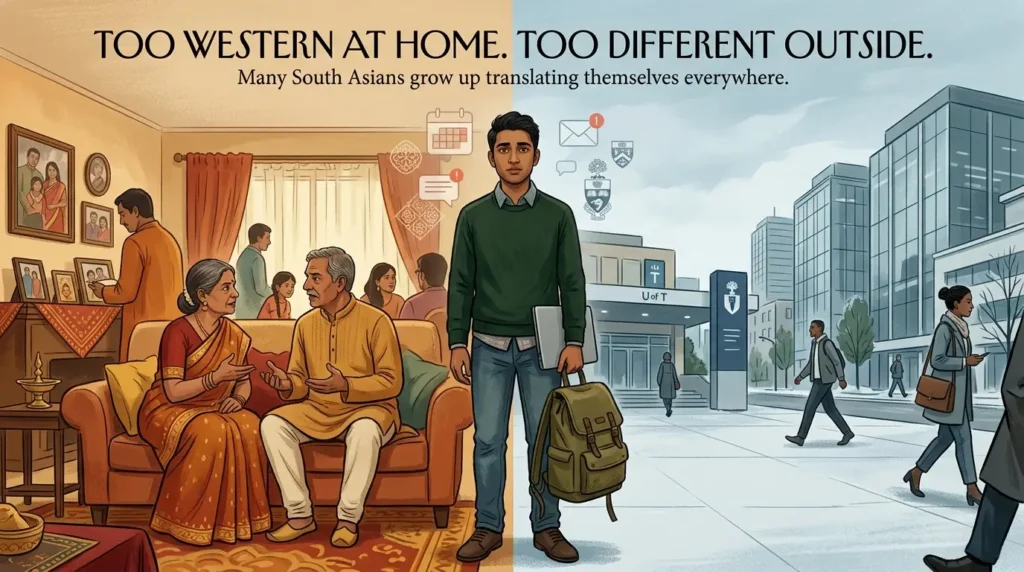
Is therapy different for South Asian people? Yes, when done well.
Standard therapy models were built on Western and individualist frameworks. South Asian family dynamics, immigration grief, or bicultural identity conflict were not given thought and space.
But culturally informed therapy holds all of that as context, not complication.
| What standard therapy can miss | What culturally informed therapy does differently |
|---|---|
| Treats family obligation as a boundary issue | Holds space for collectivist values alongside individual wellbeing |
| Doesn’t recognise immigration grief | Treats diasporic loss as legitimate, not dramatic |
| Pathologises stoicism or filial duty | Understands cultural context before drawing conclusions |
| May not grasp bicultural identity strain | Has lived experience of exactly these dynamics |
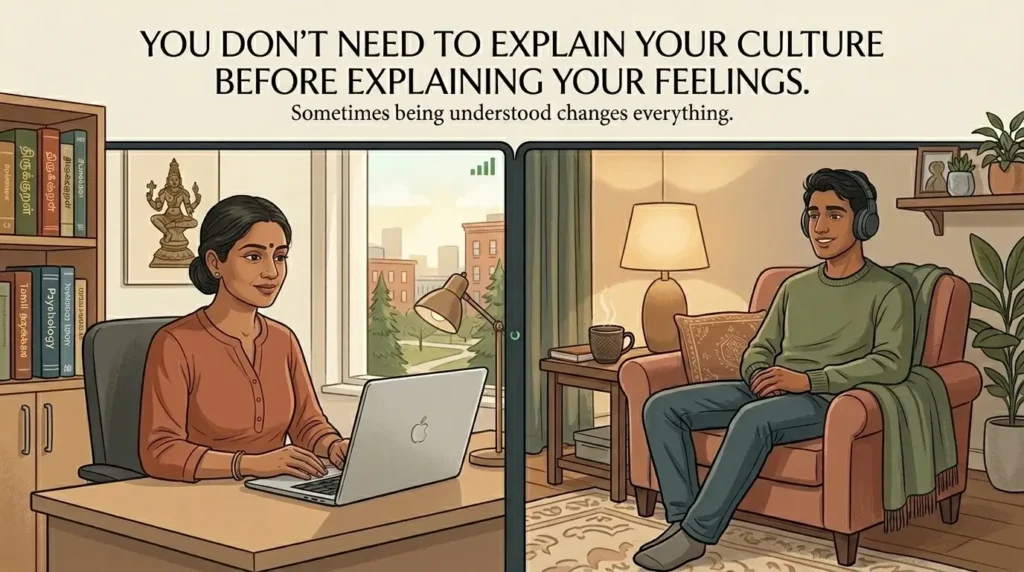
At Hap Therapy Care, Hareesma is a Tamil therapist in Ontario, CRPO-registered and offers therapy in both English and Tamil, and also has lived experience of immigration, identity conflict, & cultural expectation.
You don't have to translate your experience, because she already understands the context.
What Therapy for South Asian Mental Health Actually Looks Like
First session fears, answered honestly:
| Common worry | The reality |
|---|---|
| I’ll have to share everything immediately | You set the pace. The first session is about feeling safe, not full disclosure. |
| My family might find out | Sessions are fully confidential under PHIPA. Your family is never contacted. |
| I’ll be judged for my values or choices | Cultural context is held with respect — not pathologised. |
Virtual sessions are secure, private, and easier to fit around family schedules.
Most discussions in therapy for South Asian adults are around: identity conflict between home culture and Canadian life, family expectations & the guilt they carry, career pressure and the fear of disappointing parents, relationship patterns inherited across generations, and the grief of migration (the people, places, and sense of belonging left behind).
None of these is unusual, and all of them are worth addressing.
Seeking Help Is an Act of Strength
In a culture that prizes sacrifice, endurance, & putting the family first, choosing to address your own wellbeing takes real courage, not weakness or selfishness.
The generation before us did not have the language for this, access to it, or permission for it. But you do.
Using it is one of the most quietly brave things you can do, for yourself, and for whoever comes after you. Because you don’t have to be in crisis to deserve support, you just have to acknowledge that you are tired of carrying it alone.
Start with a Conversation
At Hap Therapy Care, you don’t have to explain your background in the first session. Hareesma already understands the context.
A free 15-minute discovery call is just a conversation, online, confidential, no referral required, available in Tamil or English across Ontario.
Book your free 15-minute consultation
Book at haptherapycare.janeapp.com →
Virtual • Confidential • Tamil & English • Ontario-wide
Related reading: About Hareesma | Services | Counselling for International Students